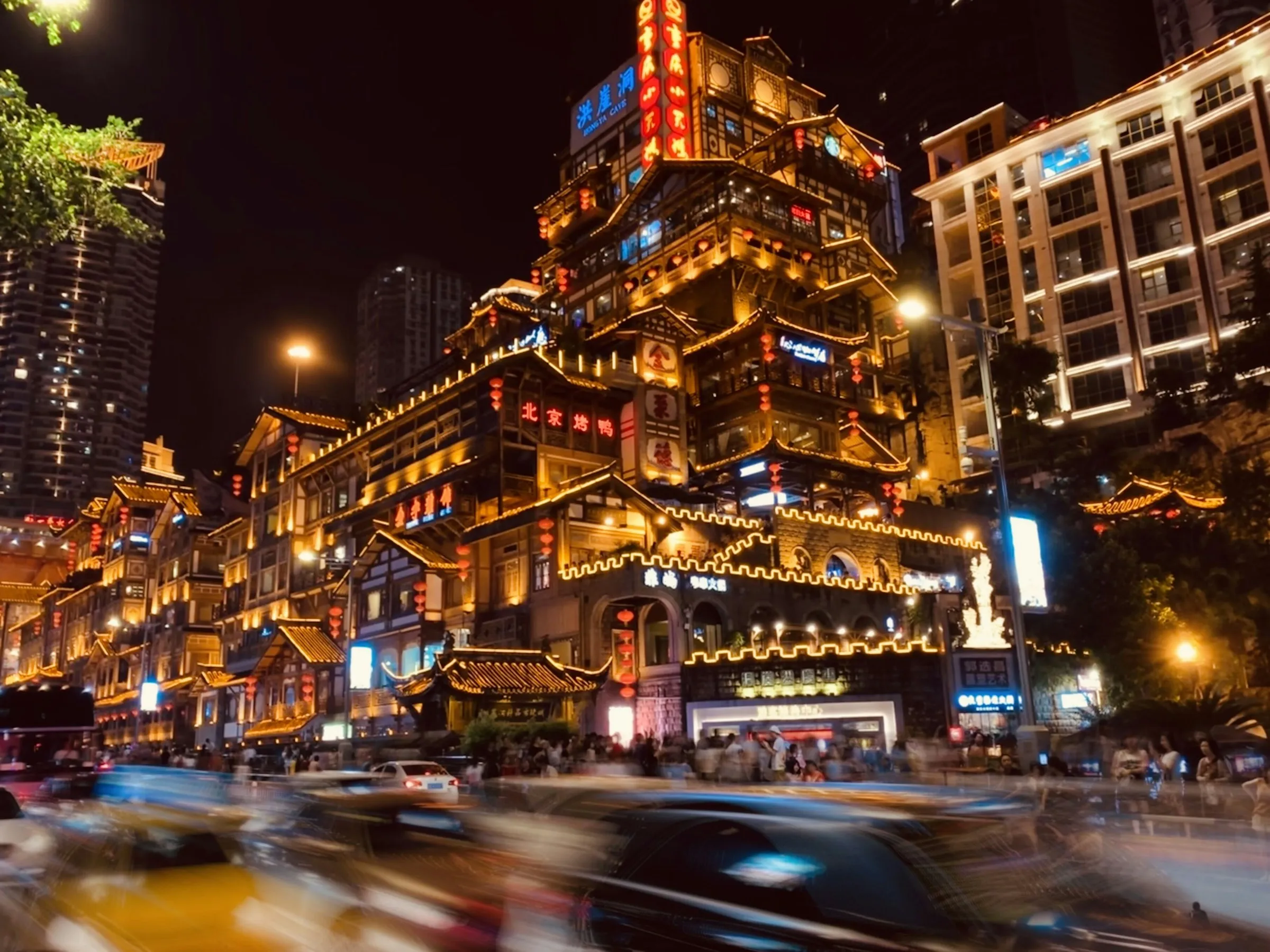
Vertical, foggy, and the fiercest hotpot in China
Chongqing重庆
Chongqing is built up a gorge, so nothing is on one level — the street door of a building can be its eighth floor, and the map lies about how long anything takes. Lean into that: ride the monorail through a tower block, take the cable car over the river, and eat hotpot until you sweat.
Getting around
Metro, Didi, and paying for it
Chongqing does not work on a flat map. Buildings open onto the street at different floors, so an address that says “1F” might be eight storeys above the road you came in on. Give everything more time than it looks like it needs, and use the vertical transport the city has built for exactly this: the metro (lines 1 and 2 cover the centre; line 2 is the one that runs through the building at Liziba), the cross-river cable cars, and the free public escalators and lifts that connect street levels.
For anything else, use Didi — street taxis are common but the hills and one-way systems make a booked car simpler. Tap your Alipay or WeChat QR at the metro gate; no separate card needed.
Long-distance trains use Chongqing North (Chongqingbei), with the high-speed line to Chengdu in about 1h15 and Xi’an in around five hours. Jiangbei International Airport (CKG) is about 20 km north, on metro lines 3 and 10.
Eat
What to eat, and where
Chongqing hotpot is the reason to come hungry — an all-beef-tallow broth, far fiercer and more numbing than Chengdu's, usually served in a nine-grid pot (九宫格). The one rule: skip the "internet-famous" check-in restaurants. Those are paid placements. Walk into a small, plain neighbourhood joint instead — you almost never go wrong.
Hotpot (火锅)
All beef-tallow, very numbing. Ask for a 鸳鸯 split pot if the heat worries you, and order plenty of tripe, luncheon meat and potato. Avoid the photographed 'net-red' shops.
Chongqing xiaomian (小面)
The morning bowl: chewy noodles in chilli oil, Sichuan pepper, preserved veg and peanuts. Eaten standing or at a plastic stool by 8am.
Jianghu cai (江湖菜)
Chongqing's home-style spicy cooking — laziji (dry chilli chicken), maoxuewang (blood curd and offal stew), quanshui ji. Order for the table.
Where to actually eat: for hotpot, follow the locals into a scruffy street-level place rather than anything with a queue of people taking photos. For breakfast, Chongqing xiaomian (小面) — a bowl of chilli-and-Sichuan-pepper noodles — is the ritual; Zhao Wu Mian Zhuang (赵伍面庄) is a reliable name. Hongyadong and Jiefangbei have food, but it's tourist-priced and rarely the best version.
Itinerary
A rough plan
- Day 1
The vertical centre
Shancheng Trail (山城步道) for the climb-and-steps feel of the old city → Liziba monorail station for the through-the-building photo → Yangtze River Cableway across to the south bank → back to Hongyadong for the night view
Rough draft — Jiang to check the order and timings.
- Day 2
Food and the old town
Xiaomian for breakfast → Ciqikou old street (early, before the crowds) → Jiefangbei and Bayi Good Food Street for a snack crawl (off-peak) → a proper hotpot dinner in a back-street joint
Day trips
Worth leaving the city for
Dazu Rock Carvings
Song-dynasty cliff carvings, a UNESCO site and one of China's four great Buddhist grottoes. Jiang to confirm transport.
Wulong Karst / Furong Cave
The natural bridges and sinkholes used in Transformers 4, plus a huge show cave. Long day; an overnight is easier.
Watch-outs
Local things to know
- Bayi Good Food Street crowds: one street, many stalls, but shoulder-to-shoulder at peak. Go mid-afternoon or a weekday evening; avoid weekends.
- "Net-red" hotpot: the restaurants all over social media are paid placements and often mediocre. A plain neighbourhood place with locals in it is the safer bet.
- Don't collect landmarks: Jiefangbei, Ciqikou, Guanyinqiao and the rest are shopping-and-snack districts you'll pass through anyway — none needs a dedicated visit. Chongqing rewards wandering the levels between them, not ticking a list.
- Summer heat: Chongqing is a 'furnace' city — July and August sit around 38–40°C with heavy humidity. Spring and autumn are far more comfortable.
- The map is wrong: walking routes that look short can involve 100 m of vertical. Trust the public escalators, lifts and the metro rather than GPS, and build in extra time.
- Cable car queues: the Yangtze River Cableway backs up midday and at sunset. Go early morning or buy a timed ticket.
- Shoulder-pole fruit sellers: the vendors carrying fruit baskets on a pole (担担) through tourist areas rig the scale and the price — a few slices of pineapple turns into a startling bill. Locals never buy from them.
Where to stay
Which area to base yourself
-
Jiefangbei / Hongyadong
Most central: walk to the night views, the cable car and the food streets, on metro lines 1 and 2. Busy and not cheap. Jiang to confirm picks.
-
Guanyinqiao (Jiangbei)
A big shopping district across the river — more local, well connected, good value, a short hop from the centre.
-
Nanbin Road (南滨路)
River promenade on the south bank with the postcard view back at the skyline. Quieter; you commute in for sights.
In the city
Sights: go, maybe, skip
- Go Hongyadong (洪崖洞) — Go after dark — the stilt-house complex lit up over the river is the city's signature view, with a Studio Ghibli look to it. Daytime is just a busy mall.
- Go Shancheng Trail (山城步道) — A walking path through the old cliffside city — steps, stilt houses, tea shacks and views. The best way to feel Chongqing's up-and-down.
- Go Bayi Good Food Street (八一路好吃街) — One-stop small eats — many stalls, many snacks. Worth it if you time it off-peak.
- Maybe Yangtze River Cableway (长江索道) — A cabin ride over the river with views of both banks. Some find it underwhelming and the queue is real, but it's a fun once. Ride early.
- Maybe Liziba monorail station (李子坝) — The metro runs through a residential tower here. Everyone comes for the photo from the viewing platform below — go if that shot appeals, it's a quick stop.
- Maybe Jiefangbei (解放碑) — The central landmark and luxury-shopping crossroads. You'll pass through on any city walk; not a destination in itself.
- Maybe Ciqikou old street (磁器口) — A restored Ming–Qing street on the river. Genuinely atmospheric early morning; a snack-stall crush by lunch. Jiang to give the honest verdict.
- Maybe Guanyinqiao (观音桥) — Chongqing's big local shopping-and-eating district across the river. Good for a real meal and people-watching, not a sight to plan around.
FAQ
Common questions
How many days do I need in Chongqing?
Two days covers the centre — the night views, the cable car, the food streets and a hotpot dinner or two. Add a third day for Dazu or Wulong.
When is the best time to visit?
March–May and October–November. Summer is brutal — Chongqing is one of China's 'three furnace' cities, with July–August around 38–40°C. Winters are mild but often grey and foggy.
Is Chongqing walkable?
Only in bursts. The city is stacked up a gorge, so 'short' walks can be long climbs. Use the metro (lines 1 and 2 cover the centre), the cross-river cable car, Didi, and the public escalators and lifts between street levels.
When should I go to Hongyadong?
After dark. The lit-up stilt buildings over the river are the whole point; in daylight it's an ordinary shopping complex.
Chengdu or Chongqing?
Do both — they're about 1h15 apart by high-speed train. Chengdu is relaxed: teahouses, pandas, gardens. Chongqing is dramatic and vertical, with a fiercer hotpot.
Next