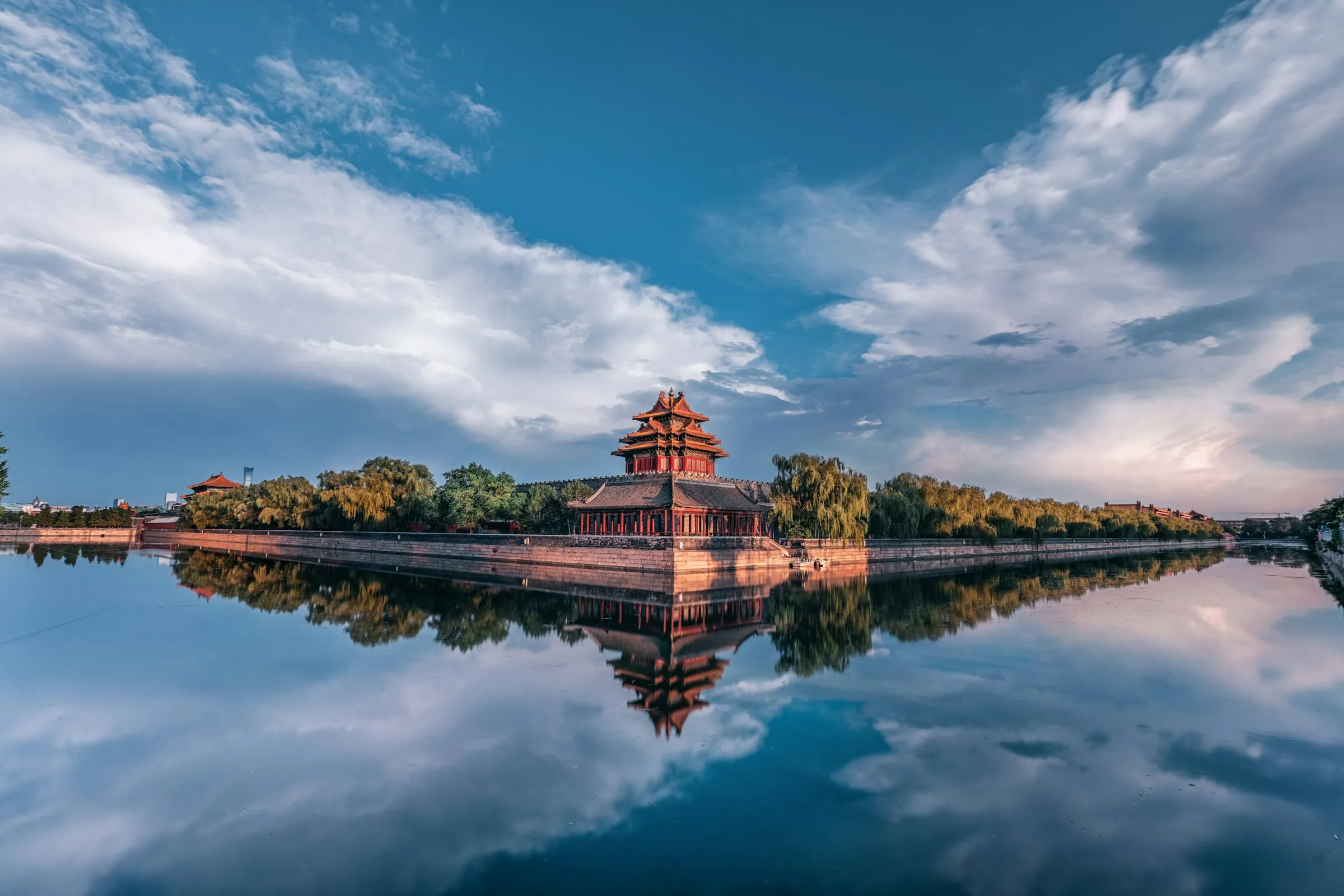
The capital: imperial history, and the Great Wall an hour out
Beijing北京
Beijing is the one Chinese city where the clichés are compulsory: you do the Forbidden City and you do the Great Wall, however many photos you've already seen. Four days is normal — one for the palace, one for the Wall, one for the old centre, one for the rest. Book the Forbidden City slot before you fly; everything else you can arrange on the day. Come in spring or autumn if you can — a January wind here cuts.
Getting around
Metro, Didi, and paying for it
Beijing’s metro is the way to move: more than 25 lines, English signage, and it reaches almost everything except the Great Wall. Tap your Alipay or WeChat QR at the gate — no separate card needed — and expect a bag scan at every station entrance, which slows things at rush hour. Trains are packed roughly 07:30–09:30 and 17:30–19:30; plan the big sights around that.
For anything off the metro, use Didi (switch the app to English). Street taxis are common, but some drivers won’t take short central hops, and around the late-afternoon shift change they thin out — Didi removes the argument.
From the airports: Capital (PEK) has the Airport Express train to Dongzhimen, then the metro; Daxing (PKX) sits on metro line 19 and its own express. Both are a solid hour to the centre, so leave time for an outbound flight.
For the Great Wall there’s no metro — it’s a tour bus, a chartered car, or the tourist bus from Deshengmen to Badaling. See Day trips.
Money
What a day here costs
Shoestring
¥220–350
per day
Comfortable
¥500–850
per day
No thought
¥1500+
per day
| Hostel dorm | ¥70–140 |
|---|---|
| Mid-range hotel | ¥300–600 |
| Nicer hotel | ¥800–1700 |
| Cheap meal / street food | ¥15–45 |
| Sit-down meal, per person | ¥80–180 |
| Metro ride | ¥3–9 |
| Typical day trip, per person | ¥250–500 |
Rough ranges in yuan, per person, for a mid-2020s trip — a guide for budgeting, not a quote. Beijing runs about 15–20% above Chengdu, hotels most of all. Cash is almost never needed — Alipay and WeChat QR work everywhere, and both now link a foreign card.
Eat
What to eat, and where
Beijing's signature is Peking duck — lacquer-skinned, carved at the table, rolled into thin pancakes with scallion and sweet bean sauce. Eat it at a smaller neighbourhood place, not the big famous names, which are pricier and built for tour groups. Around the duck: charcoal copper-pot mutton hotpot, thick sauced noodles, and a lot of hutong snack stalls, some of them an acquired taste.
Peking duck (北京烤鸭)
Roast duck carved tableside, wrapped in thin pancakes with scallion and sweet bean sauce. A smaller local place beats the big famous names; Quanjude (全聚德) is the one everyone's heard of, and the most tourist-priced.
Old Beijing copper-pot mutton hotpot (老北京涮肉)
Charcoal copper pot, plain broth, paper-thin lamb, dipped in sesame paste (芝麻酱). The sesame-paste dip is the whole point.
Zhajiangmian (炸酱面)
Thick wheat noodles under a salty fried soybean-paste sauce, with cucumber and bean sprouts stirred through. Worth trying once.
Bingtanghulu (冰糖葫芦)
Skewered hawthorn berries in a hard sugar glaze — sharp fruit under the crack of the shell. The street snack to try.
Luzhu & douzhi — approach with caution
Luzhu (卤煮, offal in broth) and douzhi (豆汁, sour fermented mung-bean drink) are the local dares. Most foreign visitors struggle with both — order a small one and taste before you commit.
Where to actually eat: Nanluoguxiang and the Wangfujing snack street are for the walk and a candied-hawthorn skewer, not for dinner — the Wangfujing "scorpion on a stick" stalls are there for photos. For a real meal, head into the hutongs off the main tourist lanes.
Itinerary
A rough plan
- Day 1
Tiananmen and the Forbidden City
Tiananmen Square at opening → Forbidden City south to north on your timed ticket (~3–4h) → climb Jingshan Park directly behind it for the view back over the golden roofs → walk into the hutongs or Beihai Park for dinner
The Forbidden City only runs one way, south to north — you can't double back, so don't burn all your time in the front halls.
- Day 2
The Great Wall
A full day at Badaling by tour bus or chartered car — about 1.5h out, a few hours on the Wall, back by evening. See Day trips for how to arrange it.
- Day 3
The old centre
Temple of Heaven early → Lama Temple (雍和宫) and the Confucius Temple → afternoon around the Shichahai / Houhai lakes and hutongs → Nanluoguxiang → dinner and a drink by Houhai
- Day 4
Everything else (pick from)
Summer Palace (half day) · 798 Art District · the Olympic Green and Bird's Nest · Wangfujing · SKP
Two big sights a day is plenty here — distances are long.
Day trips
Worth leaving the city for
The Great Wall at Badaling (八达岭)
The most developed and best-connected section — and the most crowded. Every hotel and agency sells the day tour; use a proper travel agency, and at any shopping stops, look but don't buy. Mutianyu is the quieter alternative if you'd rather trade the crowds for a slightly longer trip out.
Ming Tombs (明十三陵)
The Ming imperial burial valley; the Sacred Way avenue of stone animals is the good part. Usually tacked onto a Badaling tour rather than visited alone.
Chengde Mountain Resort (承德避暑山庄)
The Qing emperors' summer retreat and its ring of Tibetan-style temples, a UNESCO site. Doable in a day by high-speed train; an overnight is calmer.
Fragrant Hills (香山)
The red leaves in late October are the reason to go — spectacular then, an ordinary wooded hill park the rest of the year.
Watch-outs
Local things to know
- The teahouse / "art student" scam: near Wangfujing and Tiananmen, a friendly English-speaker invites you to a tea ceremony or a student art show; a large bill lands afterwards. Just don't go to the teahouse — decline and keep walking.
- Black taxis: at the airports and the big stations, ignore drivers touting inside the hall. Use the official taxi rank or book a Didi. Never get in an unmetered car.
- Hutong rickshaws: the cycle-rickshaw "hutong tours" around Houhai are known for a price that multiplies at the end — a quoted ¥10 becomes ¥100 a head. Agree the full price out loud before you get in, or skip it and walk the lanes yourself.
- Forbidden City tickets: book on the official channel, bring the passport you booked with, and note it's closed Mondays. Anyone at the gate selling "sold-out" tickets, or telling you it's "closed today, come on my tour", is working a scam.
- Winter really is that cold: December to February the wind sits well below freezing — like a knife on your face. If you feel the cold, come in spring or autumn instead, or pack for a real winter.
- Holiday weeks: the first week of May and the first week of October — the national holidays — pack every major sight and push hotel prices up. Avoid those dates if you can.
Where to stay
Which area to base yourself
-
Houhai / Shichahai
The pick if you want nightlife: hutong lanes, the lake, a bar street still going when you step out of the hotel at night. Central-ish and full of character; can be noisy.
-
Sanlitun / Taikoo Li
Modern Beijing — the best restaurant and bar density in the city, big malls, the embassy district. Less historic, more comfortable; a metro ride from the old sights.
-
Qianmen / Wangfujing
Walking distance to Tiananmen and the Forbidden City, on the metro, plenty of hotels — the sensible first-timer base.
-
Near Beijing South station
Only worth it for a very early Shanghai or Tianjin train. Otherwise it's a long way from the sights.
In the city
Sights: go, maybe, skip
- Go The Forbidden City (故宫) — the imperial palace, five centuries of it. Book the timed slot ahead; walk it south to north in a half-day. Closed Mondays.
- Go Tiananmen Square (天安门) — the ceremonial centre of the country — vast, and worth standing in once. Security screening and a passport to enter.
- Go Temple of Heaven (天坛) — the round hall on its marble terraces in a big park. Go early for the locals doing tai chi, dance and choir practice under the trees.
- Go Summer Palace (颐和园) — the Qing court's lakeside garden-palace out to the northwest — a half-day of pavilions, the Long Corridor and boats. Best in clear weather.
- Go 798 Art District (798艺术区) — a Bauhaus-era factory complex turned contemporary-art quarter — galleries, studios, cafés. A must; give it half a day.
- Go Nanluoguxiang (南锣鼓巷) — the busiest hutong strip — touristy and packed, but every foreign visitor goes, and it's the spot for a candied-hawthorn skewer and the hutong feel.
- Maybe Jingshan Park (景山) — the hill right behind the Forbidden City — climb it (20 minutes) for the classic view down over the palace roofs, best at the end of your Forbidden City day. Worth it.
- Maybe Shichahai / Houhai lakes (什刹海/后海) — lakes ringed by hutongs and bars — pleasant to walk by day, lively by night. Worth it; ignore the rickshaw touts.
- Maybe Lama Temple (雍和宫) — Beijing's grandest Tibetan-Buddhist temple, with an 18-metre Maitreya carved from a single sandalwood trunk. Worth an hour.
- Maybe Olympic Green — Bird's Nest & Water Cube (鸟巢/水立方) — the 2008 stadium and pool, lit up at night. Worth a look, mostly from outside; pairs with a metro trip up north.
- Maybe Beihai Park (北海) — imperial lake park with the white dagoba on its island, next to the Forbidden City. Pretty, not essential.
- Maybe Wangfujing (王府井) — the main downtown shopping street — have a wander. The 'snack street' is a photo op, not a meal; SKP, the luxury mall further east, is take-it-or-leave-it.
FAQ
Common questions
How many days do I need in Beijing?
Three to four. A day for the Forbidden City and Tiananmen, a day for the Great Wall, a day for the old centre (Temple of Heaven, the hutongs, the lakes), and a fourth for whatever's left — the Summer Palace, 798, the Olympic park. Distances are long, so two big sights a day is the realistic pace.
When is the best time to visit?
Spring (April–May) and autumn (September–October), when the air is clearer and the parks are at their best — Jingshan and Fragrant Hills in late October are the payoff. Avoid December to February, when the wind runs well below freezing, and the first weeks of May and October, when every sight is jammed.
Which section of the Great Wall should I visit?
Badaling is the pick — the most developed and best-connected section, with day tours from every hotel, though also the most crowded. Mutianyu is the common quieter alternative. Either way, use a proper travel agency; on tours that stop at jade or 'tea' shops, look but don't buy.
Do I need to book Forbidden City tickets in advance?
Yes. Tickets are timed and sell out in peak season — book on the official channel a few days ahead and bring the passport you booked with. It's closed on Mondays. Ignore anyone at the gate selling tickets or claiming it's 'closed today'.
Which airport and station will I use?
Flights use Capital (PEK), about 25 km northeast with an Airport Express train, or Daxing (PKX), far to the south on metro line 19. High-speed trains to Shanghai and Tianjin leave from Beijing South; trains to Xi'an, Datong and the south from Beijing West.
Is Beijing worth it if I've already seen the Forbidden City and Great Wall in photos?
Yes, without reservation — in person they're compulsory, photos or not. Beijing is the country's historic and political centre, and nothing else in China stands in for it.
Beijing, Xi'an or Shanghai first?
A common run is Beijing–Xi'an–Shanghai, or the reverse, all linked by high-speed train — Beijing for imperial history and the Wall, Xi'an for the Terracotta Army, Shanghai for the modern city. See the route pages for train-vs-fly on each leg.
Next